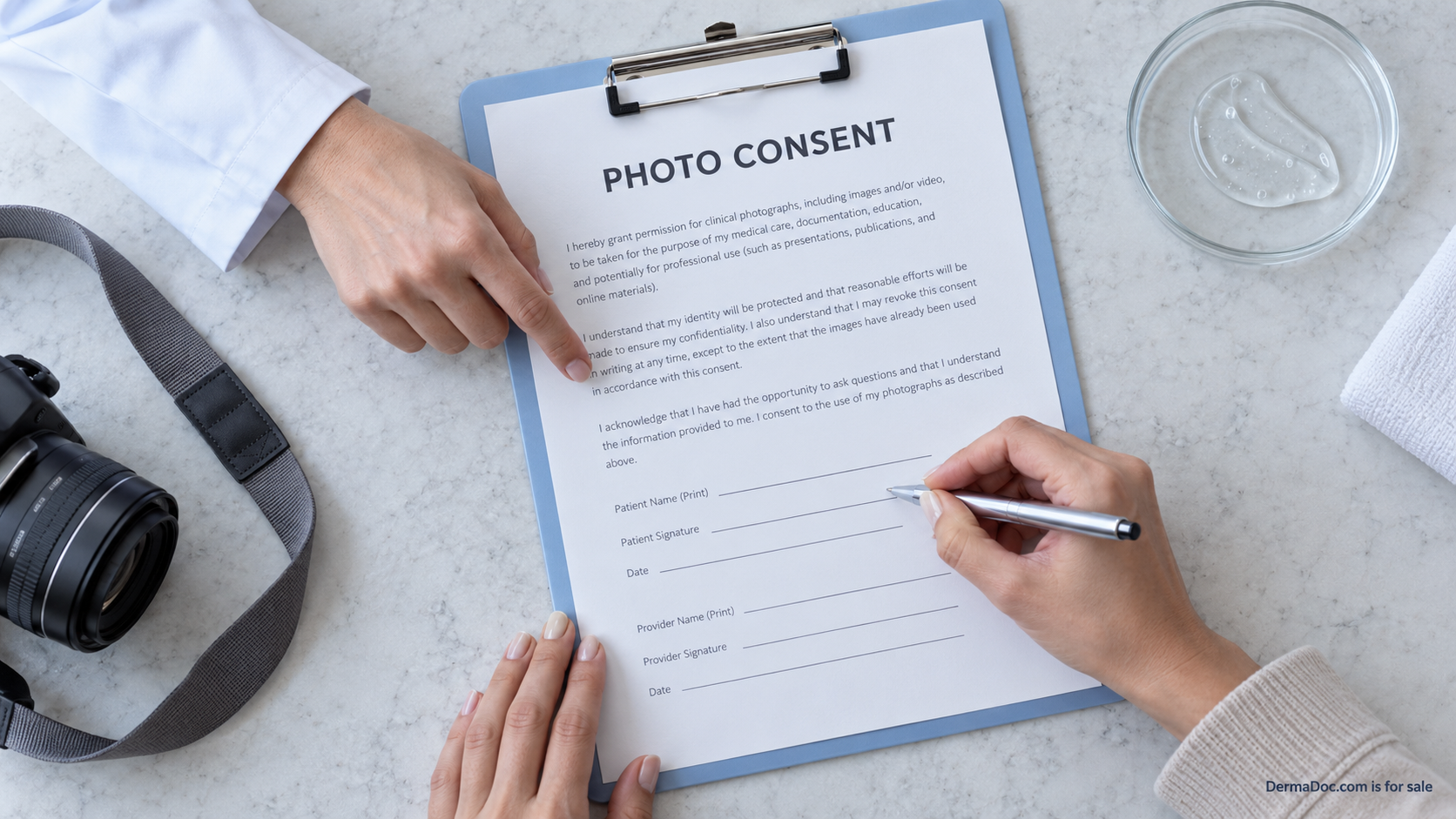
Med-spa marketing often wants faces, results, and speed. Consent and claim review need the opposite habits: slow inventory, written scope, and the courage to publish rooms and materials when releases are incomplete. This Journal guide is an operations checklist before publishing patient imagery or result-style claims. It is not legal advice. Rules vary by market. No before-and-after guarantees are recommended here.
Decide what story the photo is allowed to tell
Write the job of the image in one line. Example: "Show the consult room lighting so new clients know what the space feels like." That job does not require a patient's face. Another example: "Show a consented process photo for service X on web only." That job requires a release that matches the channel. If you cannot write the job, you are decorating, not communicating.
Doctor-forward brands can carry tone with glass, stone, linen, instruments at rest, and hands-only process shots. DermaDoc.com as an example house name does not require miracle grids to feel clinical. Restraint is a creative brief, not a lack of ambition.
Release scope checklist
- Who is pictured and who can consent.
- Channels allowed: website, organic social, paid social, print, PR.
- Duration and renewal.
- Whether before-and-after comparative use is allowed at all.
- Whether identity can be shown or must be obscured.
- Removal path and response time.
- Storage location and access list.
- Whether third-party agencies may receive the files.
Store releases where marketing and compliance can both find them. A release in a personal inbox is not an operations system. When staff leave, the archive must remain.
Claim language beside the frame
Images inherit nearby words. A careful photo under a "guaranteed transformation" headline becomes a claim vehicle. Audit captions, alt text, and adjacent bullets. Prefer process captions ("consult room, morning light") over outcome captions ("flawless after one visit"). If comparative photos are used where allowed, include dates and a clear note that results vary. Many teams choose not to use comparative grids publicly; that choice reduces a whole class of disputes.
US teams should treat FTC truth-in-advertising principles as baseline orientation and add state and professional rules as required. See the FTC advertising and marketing hub for starting points, then involve counsel for your markets.
Ops sequence before a campaign ships
- Select candidate assets.
- Match each asset to a release.
- Confirm channel scope includes paid if the campaign is paid.
- Run claim review on copy and captions.
- Confirm landing page matches the creative.
- Confirm retention and takedown contacts are current.
- Ship with a named owner for comments and complaints.
If any step fails, substitute non-patient imagery. A late creative swap is cheaper than a public consent dispute.
Worked example: rewriting a risky carousel
Risky: three unverified face transformations with "permanent results" stickers and no dates. Safer: one consult-room photo, one materials still, one hands-only process shot, captioned as process, linking to a consult CTA. Conversion may change. Consent posture improves. Doctor-forward positioning stays intact.
Staff and vendor brief
Front desk, injectors, photographers, and social contractors need the same forbidden list. Provide a one-pager: no secretly captured photos, no posting from personal phones to brand channels, no inventing outcomes in comments, no sharing raw files into personal clouds. Vendors sign the brief. Refresh quarterly.
Takedown and complaint handling
Publish an internal SLA. Who receives the request, how identity is verified, how fast assets are removed from owned channels, and how partners are notified. Track requests without turning the tracker into a public shame board. Do not argue clinical details in public replies.
When not to photograph patients for marketing
If releases are incomplete, if staff are rushed, if a client is distressed, or if the only brief is "we need before-and-afters by Friday," stop. Non-patient photography exists for this reason. Brand tone can still be clinical, calm, and specific.
Lighting, identity, and implied results
Photography choices imply claims even when captions stay quiet. Hard beauty filters, dramatic score overlays, and timestamp theater can invent a transformation narrative. Prefer consistent lighting notes and modest retouching policies written down for vendors. If identity must be obscured, do it before the asset enters the marketing library, not as a last-minute emoji sticker on social.
Build a rejected-assets folder with reasons. New contractors learn faster from labeled rejects than from abstract policy PDFs. Include examples of cropped releases that no longer match the frame, captions that overclaim, and carousels that mix consented and unconsented shots.
Multi-location and franchise complications
If more than one location markets under one house name, centralize release storage and claim review. Local teams invent local exceptions. A shared library with channel tags prevents a single office from launching paid face grids the brand already retired. When a location leaves the network, have a contract path for asset withdrawal.
Franchise-style partners need the same one-pager as W-2 staff. Brand guidelines that only discuss logo clear space and ignore consent will not protect a doctor-forward position. Add consent and claim rules to the brand book at the same level as typography.
Paid social pre-flight script
- Asset ID and release ID match.
- Paid channel explicitly allowed.
- Landing page uses the same service name and no stronger claim.
- Audience geo matches where the service is offered.
- Comment macros loaded for the launch window.
- Owner named for takedown within the SLA.
Print this list beside the ads manager. Teams skip steps they cannot see. A two-minute pre-flight prevents a week of cleanup.
Alternative creative that still feels clinical
When patient imagery is unavailable, shoot materials, rooms, sterile trays at rest, linen, stone, and soft daylight. Include the house name on stationery in frame when it helps recognition. These stills support a DermaDoc.com-style register without outcome guarantees. They also travel better across cultures where face-forward medical advertising is restricted or culturally uncomfortable.
Pair stills with process copy: how consults work, what to expect on arrival, how aftercare questions are handled. Process content converts clients who want clarity. Outcome theater attracts disputes.
Next step: review one live campaign against this checklist. If you are evaluating DermaDoc.com for a doctor-forward med-spa, read that Idea and inquire with service list and locations. Purchase paths are GoDaddy or Escrow.com. This article does not approve your creative.